Bitcoin Mining Industry's Exponential Growth Just Won't Stop
A decade ago when Satoshi Nakamoto unleashed the Bitcoin
network, the security behind the protocol was guarded by only a few
miners. These days, mining the SHA-256 algorithm has become a thriving
industry that hasn’t stopped growing. Also Read: Exploring the SLP Token Universe Built on the Bitcoin Cash Chain
Bitcoin Mining Pools and ASICs Change the Game
Every waking second of the day, bitcoin miners are crunching numbers,
humming away in facilities that few people who use the network have
ever seen. Miners from large facilities who form giant pools stem from a
variety of provinces around the world. In the early days up until 2010,
individuals mined bitcoin with a central processing unit (CPU). This was until people like Laszlo Hanyecz, the man who traded 10,000 BTC
for two pizzas, and Artforz mined the cryptocurrency with a graphics
processing unit (GPU). Artforz was an anonymous individual but became
the talk of the bitcoin community during the early days after he created
the first “farm” of GPU miners. In July 2010, Artforz said he had about 4% of the global hashrate at the time, mining 1,700 coins in six days. Less than three months later, people claimed the anonymous individual’s “Artfarm” controlled between 20-30% of the network hashrate. In September 2012, the second year of the nascent BTC network, the processing power was only around 10,000,000,000,000 (ten trillion) hashes per second (10 TH/s)
A year before Artforz fired up his GPU farm to mine bitcoin, Satoshi
Nakamoto asked the community to slow down on the mining arms race in
December 2009. “We should have a gentleman’s agreement to postpone the
GPU arms race as long as we can for the good of the network. It’s much
easier to get new users up to speed if they don’t have to worry about
GPU drivers and compatibility. It’s nice how anyone with just a CPU can
compete fairly equally right now,” Nakamoto said
at the time. The GPU arms race sparked the creation of the first mining
pools in November 2010, when Marek Palatinus, otherwise known as
“Slush,” formed a pool (Slushpool) because
“mining became very hard for other people” after GPU enabled computers
entered the fray. With mining pools, a collective of individual miners
sharing profits became all the rage, and the summer of 2011 saw the
inception of field-programmable gate arrays (FPGAs). The
infamous Artforz was one of the first individuals to start a GPU mining
farm called the “Artfarm,” which was estimated to control between
20-30% of the network hashrate in 2010.
As soon as FPGAs were created, many bitcoiners knew
application-specific integrated circuits (abbreviated as ASIC) were on
the way very soon. Unlike the machines used in the past, ASICs are
integrated circuits that have one specific job, which is to mine the
SHA-256 algorithm. ASICs and pools quickly turned bitcoin mining into an
industry and hobbyist miners began to contribute less over the next few
years. Moreover, mining bitcoin without an ASIC became unprofitable and
the CPU, GPU and FPGA days quickly came to an end in 2013. Roughly
around this time, Avalon released its first set of ASICs and bitcoiners
witnessed the birth of companies like Bitmain, Kncminer, Hashfast,
Bitfury, Cointerra, and Butterfly Labs (BFL). From here the mining
ecosystem went into overdrive and digital currency fans saw giant mining
pools like Ghash.io and Btcguild gathering 51% of BTC
network’s mining power. Many of the mining manufacturers are now
bankrupt but some companies like Bitmain, Bitfury, and Slushpool have
remained relevant over the years. The BTC network hashrate didn’t touch 1 exahash per second (EH/s) until January 2016.
The Exahash Era, SHA256 Between Two Chains and Pool Distribution
The BTC network’s hashrate did not surpass 1 exahash per second (EH/s) until January 25, 2016. A year later, after August 1, 2017, well known and unknown mining pools processed both BTC and BCH transactions that summer and still do to this day. In mid-November, during the crypto bull run of 2017, the BTC network processed 10.8 EH/s, while the BCH
network was around 5 EH/s. Interestingly, when markets plummeted
downward in 2018, SHA-256 hashrates continued to climb, seeing little
downward pressure. This was the highest profile split in history where
two chains with the same algorithms saw large mining pools jump back and
forth between chains depending on profitability. Moreover, on November
15, 2018, when the BCH/BSV split occurred, miners from the BTC network stepped in during the hashwar. Additionally, after the BSV fork, both BTC and BCH
chains saw a considerable drop in hashrate and price per coin. Both
chains have been gradually increasing in value and gathering far more
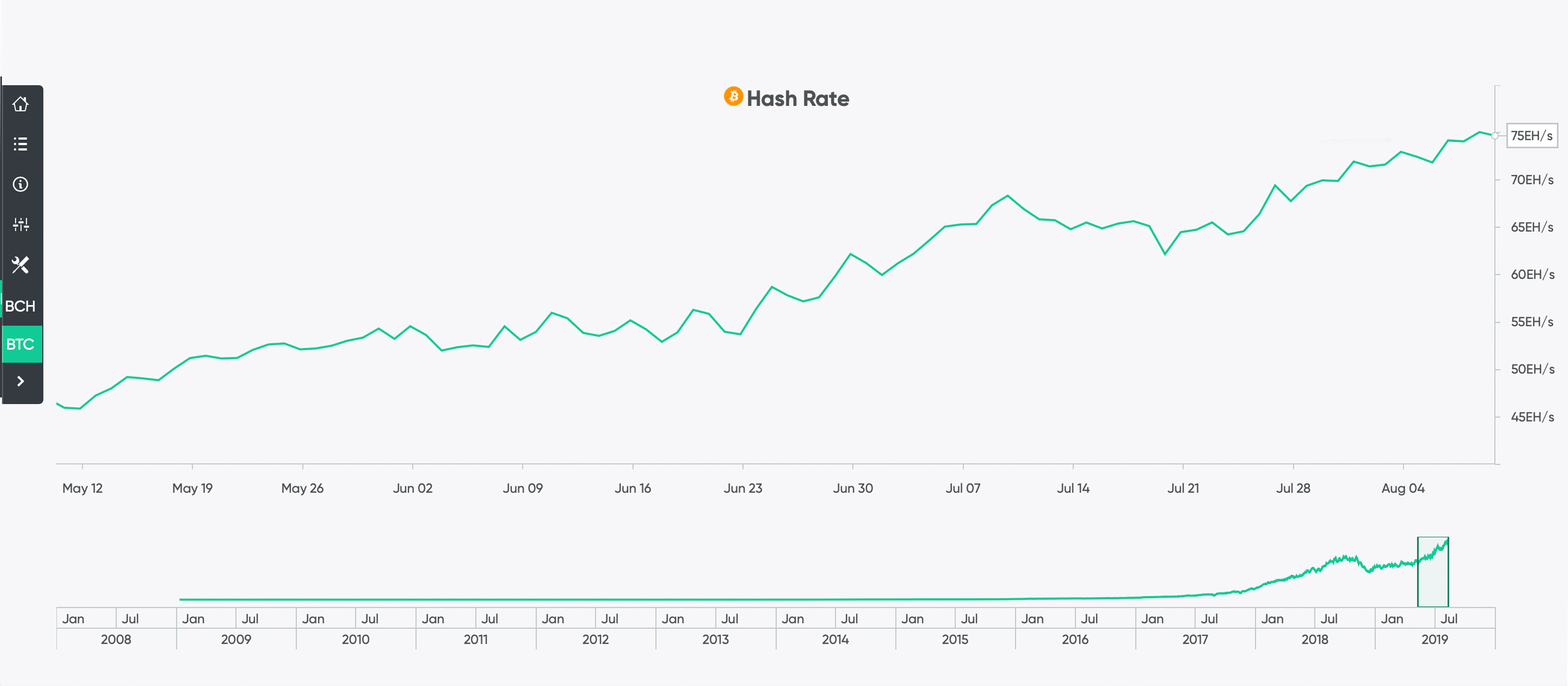
processing power in 2019. BTC hashrate on August 11, 2019 – 75-80 EH/s.
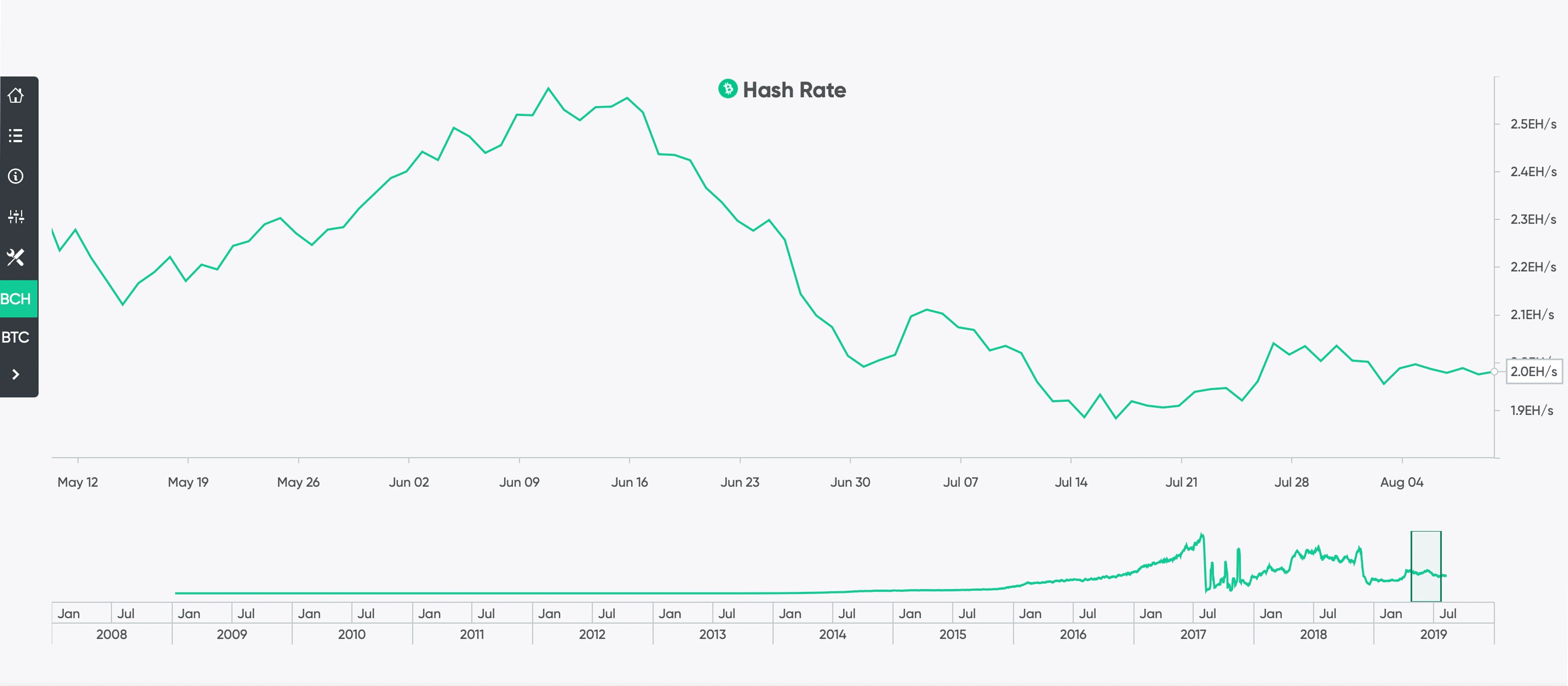
Currently, between BTC and BCH, there’s a whopping 75-80 EH/s processing both chains, with 75 EH/s on BTC and 2.24 on the BCH network today. There’s no doubt 80 EH/s is a monumental milestone for the BTC
network and the metric is steadily approaching 100 EH/s, which would be
20% of one zetahash. One zetahash per second (ZH/s) is an unfathomable
1,000,000,000,000,000,000,000 (one sextillion) hashes per second. After
the November 2018 hashwar, the 4-5 EH/s of processing power split into
two (BCH and BSV) and both chains saw a low of under 1 EH/s. The BCH chain has gradually seen an increase of hashpower and has gathered over 2 EH/s in recent months. BCH hashrate on August 11, 2019 – 2+ EH/s.
During the second year of the nascent BTC
network, the processing power was only around 10,000,000,000,000 (ten
trillion) hashes per second (10 TH/s). Because the tech has improved a
great deal, a single mining rig can produce over 10 TH/s these days.
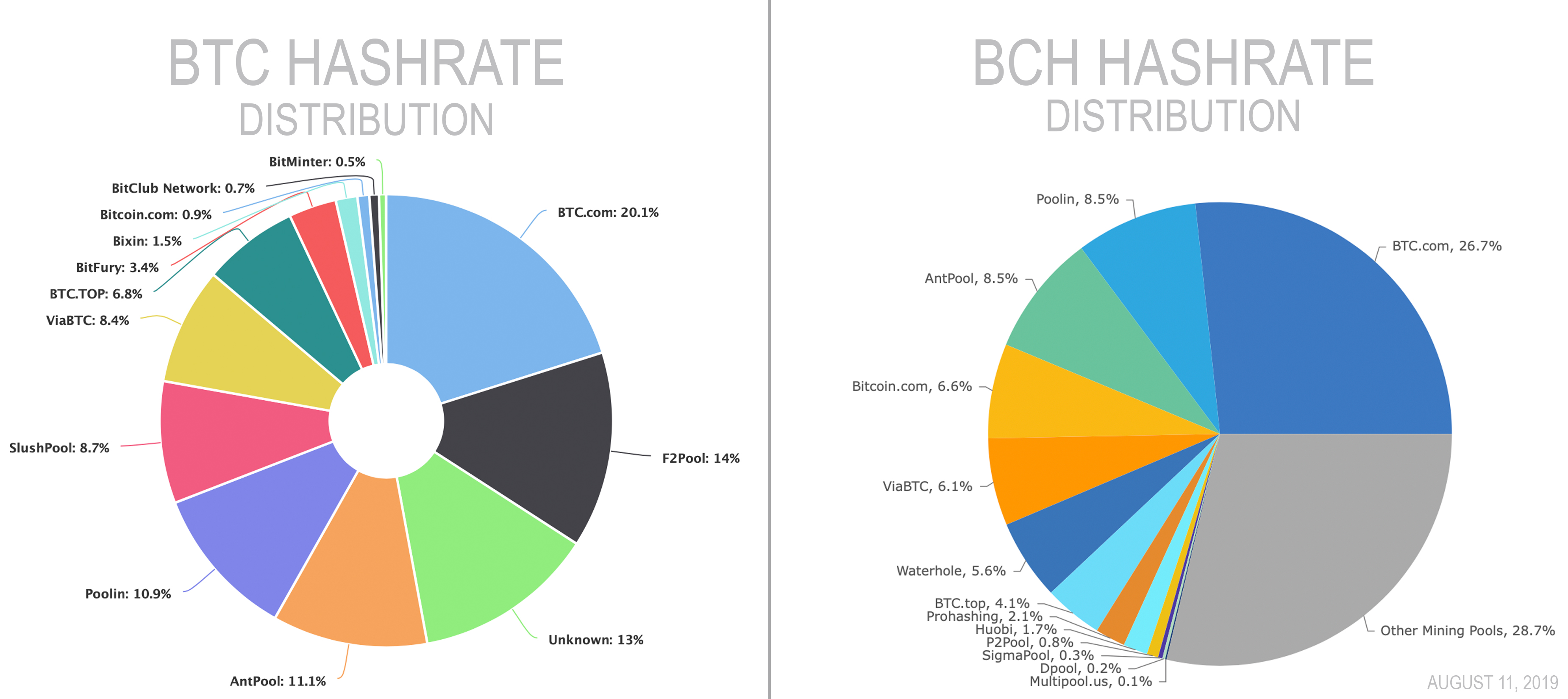
After the second year anniversary of the split in 2017, the BCH hashrate is thousands of times larger with the network’s maintained two quintillion hashes per second. The BCH chain has roughly 14-15 known miners and around 29% of the overall hashrate from unknown pools. There are 12 known miners processing BTC transactions at the moment and 14% of the mining power is controlled by unknown miners as well. Additionally, six well-known BTC mining pools also mine the BCH chain as there’s sustained hash dedicated to both networks at all times. The four largest BCH mining pools are Btc.com, Antpool, Poolin, and Bitcoin.com. Btc.com is also the biggest pool mining on the BTC network followed by F2pool, Antpool, and Poolin. BTC and BCH hashrate distribution on August 11, 2019.
2019 Mining Rigs and Next-Generation Semiconductors
In December 2018, during the crypto winter’s lowest of lows, only
five SHA-256 mining rigs were profitable at the time. At an average
electricity cost of $0.13 per kWh, machines that produced more than 28
TH/s profited at only $0.27 to $1.39 per day depending on the model. Now
more than 40 mining devices on the market are profitable at 13 cents
per kWh based on electric costs at current exchange rates. The top
mining rigs profiting the most include a device by Microbt Whatsminer,
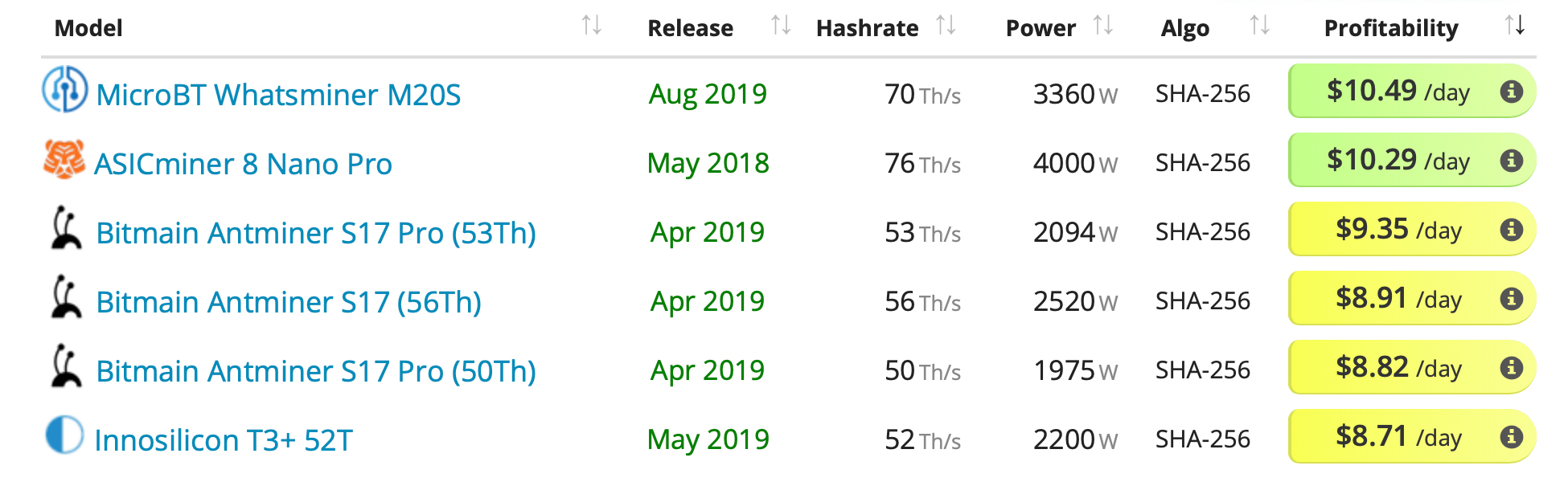
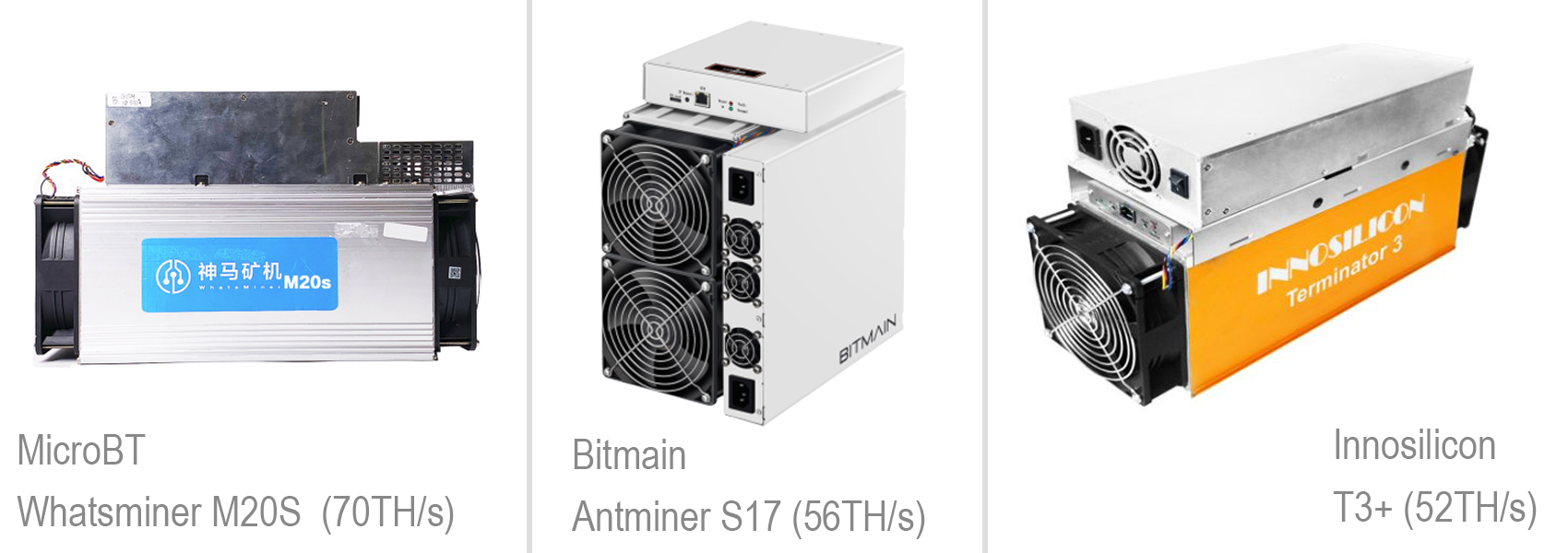
and three models by Bitmain. The Microbt Whatsminer M20S (70TH/s) is
profiting by $10.49 per day and the three newly manufactured Antminer
S17 series (50-56 TH/s) can make a touch above $9 a day. Top mining
manufacturers in the second half of 2019 include firms like Bitmain,
Canaan, Ebang, Innosilicon, Strongu, and Microbt. The
top six most profitable SHA-256 mining rigs during the month of August
2019. (At an average electricity cost of $0.13 per kWh)
It will be interesting to see how the mining industry develops over
the next 10 years. There’s a lot of money and electricity being used to
mine SHA-256 coins and it doesn’t look like it will be slowing down
anytime soon. Many of the aforementioned mining chip manufacturers above
have made massive amounts of money and have become some of the largest
IT companies in the world. Because of this, large mining firms like Canaan and Bitmain
have filed for an initial public offering (IPO) in the U.S. Last
December, the mining equipment maker Ebang filed a draft IPO prospectus
with the Hong Kong Stock Exchange (HKEX). Do you want to maximize your Bitcoin mining potential? Plug your own hardware into the world’s most profitable Bitcoin mining pool or get started without having to own hardware through one of our competitive Bitcoin cloud mining contracts.
Mining has also bolstered the International Technology Roadmap for
Semiconductors by introducing machines that utilize the 7 nanometer
(7nm) node design. Production of 256 Mbit SRAM semiconductors using a
7nm process started in 2017 in Taiwan. China-based mining manufacturers
have deployed a variety of newer mining devices that use next-generation
7nm semiconductors. Bitmain has released more than five different
miners in 2019 with 7nm chipsets stemming from the Taiwan Semiconductor
Manufacturing Company (TSMC). Local reports in China have revealed that Bitmain recently placed an order for “30,000 7nm wafers from TSMC.”





No comments: